Regulation, Policy & Government
Key responsibilities include:
Develops and reviews medicines regulations, policies, and national guidance.
Ensures medicines meet legal, safety, and quality standards.
Evaluates evidence to support licensing, approval, and post-marketing surveillance.
Advises government bodies on medicines safety, shortages, pricing, and public health priorities.
Works with regulators (e.g., MHRA) on pharmacovigilance and drug safety monitoring.
Contributes to health policy development, including prescribing standards and national frameworks.
Engages with stakeholders (clinicians, industry, policymakers) to support safe, effective healthcare delivery.
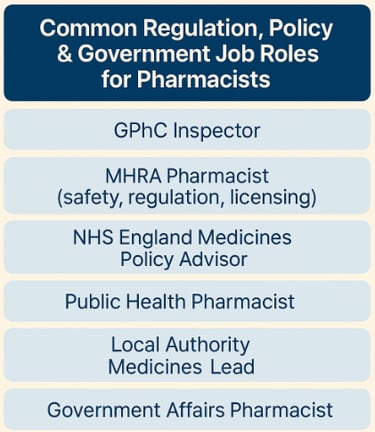
A pharmacist working in regulation, policy, or government helps shape how medicines are approved, monitored, supplied, and used at national or organisational levels. Instead of working directly with patients, they influence the bigger system: ensuring medicines are safe, effective, high-quality, and used appropriately across the healthcare landscape. Their work supports public health, national strategy, and the legal frameworks that govern pharmacy and medicines.
Regulatory pharmacists (e.g., at the MHRA or EMA) ensure medicines are safe, effective, and high-quality. They review evidence from clinical trials, assess risk–benefit profiles, evaluate manufacturing compliance, and make decisions about licensing, safety alerts, and post-marketing surveillance.
Policy pharmacists work on designing national healthcare policies, medicines optimisation strategies, public health initiatives, reimbursement frameworks, and national clinical guidelines. They collaborate with civil servants, clinicians, academics, patient groups, and government bodies to create evidence-based policies that improve population health.
Pharmacists in government roles may also contribute to pandemic response, vaccination strategies, controlled drug legislation, workforce planning, health technology assessment, and national safety programmes (e.g. Yellow Card). The work is varied, intellectually demanding, and has enormous impact.
Career progression is structured but diverse. Many pharmacists complete additional qualifications such as public health (MPH), health economics, regulatory affairs, policy analysis, or leadership programmes.
Leadership & Government Management Route
Pharmacists who enjoy strategic oversight, team leadership, and national influence can progress to:
Head of Medicines Policy
Chief Pharmaceutical Officer Team roles
Director of Medicines Regulation
National Programme Lead (NHS England)
Government Advisor on Medicines & Pharmacy
These roles involve shaping national strategies, overseeing regulatory departments, leading safety programmes, and influencing legislation.
Specialist Regulatory/Policy Expert Route
Pharmacists who prefer technical expertise and evidence analysis can progress into:
Senior Regulatory Scientist (MHRA/EMA)
Health Technology Assessment Specialist (NICE)
Pharmacovigilance Assessor
Public Health Pharmacist
Medicines Safety or Controlled Drugs Specialist
These roles focus on deep scientific evaluation, guideline development, and technical policy work.